Showing posts with label RWANDA. Show all posts

Tuesday, May 23, 2017

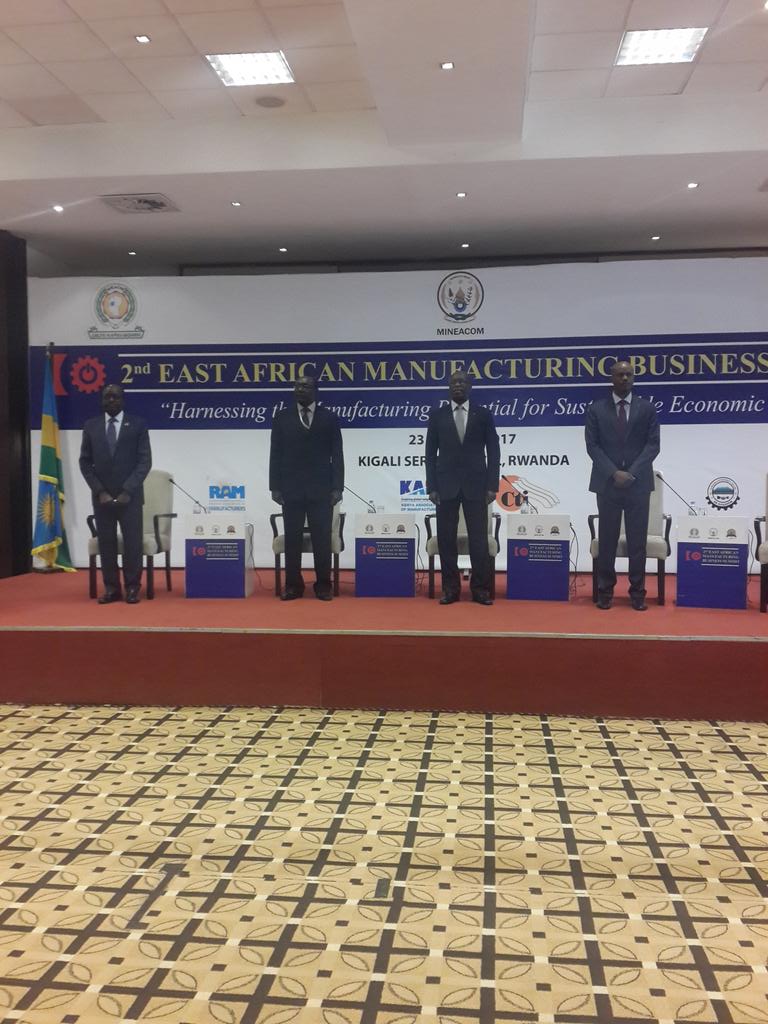
AUSC delegates in the 2nd East African Manufacturing Business Summit and Exhibition to share the AUSC International Action Plan 2016-2019

The 2nd high-level Manufacturing Business Summit and Exhibition themed “Harnessing the Manufacturing Potential for Sustainable Economic Growth in the East African Community (EAC) scheduled as a three day event, started on this 23rd  and will end on 25th May 2017 at Serena Hotel in Kigali, Rwanda. This high-level conference is co-organized with the East African Community (EAC) with very strong support from the Rwandan Government. The event is co-hosted by the East African Business Council (EABC) and the East African Manufacturing Associations i.e. the Rwanda Association of Manufacturers (RAM), Uganda Manufacturers Association (UMA), Confederation of Tanzania Industries (CTI), Burundi Manufacturers Association (AIB), and Kenya Manufacturers Association (KAM).

Over 300 top executives in the manufacturing and agri-business sectors, high-ranking policy and decision makers, as well as leading financial institutions from Africa and beyond  are one of the participants, according to the EAC Secretariat. 
The President of Rwanda, Paul Kagame was  expected to grace the official opening ceremony of the Summit, but came the Prime minister Anasthase Murekezi representing him.

The AUSC Members have been invited to attend this summit. The AUSC President's Office selected 9 special Delegates who were accredited to attend for this first day of the summit and will keep participating in different sessions of this summit.

The 2nd East African Manufacturing Business Summit and Exhibition is offering exhibitions where investors, enterprises, researchers and academia can collectively showcase new products and services as well as latest innovations in manufacturing, particularly those with relevance to small and medium enterprises (SMEs). 

The 2nd high-level Manufacturing Business Summit and Exhibition is the follow up of the 1st Manufacturing Business Summit and Exhibition which took place at the Speke Resort Hotel, Munyonyo in Kampala, Uganda  in 2015.
The biannual East African Manufacturing and Business Summit is being organized against a backdrop of economic resurgence and high political commitment to pursue development driven by industrialization. The forum therefore stands to offer an important platform for governments in the region to engage the private sector on critical steps needed to leverage higher levels of investment in manufacturing.
The expected outcome is significant impact on broader socio economic development objectives such as employment creation, technology transfer and wealth creation.   The forum seeks to create an avenue for the private sector to advocate and campaign for the acceleration of industrial reforms aimed at improvement of investment conditions in the EAC strategic sectors.

The EAC region has already identified strategic areas for industrial development in the region that bear comparative advantages and where significant private sector investment is needed to unlock potentials. These strategic sectors include: agro-processing and agri-business; mineral processing; pharmaceuticals; construction materials; fertilizers & agro-chemicals as well as the strengthened leather & textiles and automotive sector.


Keep following the activities of this summit online via AUSC Facebook, Twitter and Website.
You can use the hash tag #2EAMBS to follow this summit.


Friday, September 23, 2016

CALL FOR PAPERS: Tshwane University of Technology – Journal of Creativity, Innovation and Social Entrepreneurship (TUT – JCISE)

color_logo_portrait
CALL FOR PAPERS
Tshwane University of Technology – Journal of Creativity, Innovation and Social Entrepreneurship (TUT – JCISE)

The first  workshop leading to the publication of the Tshwane University of Technology Journal of Creativity, Innovation and Social Entrepreneurship (TUT – JCISE) will be held on January 19, 2017.

Background
Tshwane University of Technology - Journal of Creativity, Innovation and Social Entrepreneurship (TUT-JCISE) is a peer-reviewed annual publication of the South African Research Chair Initiative (SARChI) in Innovation Studies, Research & Innovation (R & I) Directorate and School of Management Sciences of Tshwane University of Technology (TUT). The values of Africa encourage Social Entrepreneurship where creating novelty is not just for Economic gain but also Social and Environmental gains. This journal will serve to stimulate and inspire Knowledge Creation on how Social Entrepreneurship will promote human and nature well-being and development to make a better future for all.
TUT-JCISE will be a strong scholarly publishing outlet mainly but not exclusively for TUT graduates and doctoral candidates to develop their publishing skills. Soon it will include scholarly works from researchers of South Africa, rest of the Africa and the Global South.


TUT-JCISE can publish papers dealing with Basic and Applied Research in
the areas of Creativity, Innovation and Social Entrepreneurship. The following types of papers are invited in TUT-JCISE:
  1. Original Research Papers;  
  2. Topical and relevant, research notes;
  3. Book Reviews;
  4. Unique Innovative Entrepreneurial Case Study Reports;
  5. Dissertation abstracts;

TUT-JCISE calls for papers for its first Issue Schedule to be published before March, 2017 under the following themes and the subthemes.

Theme

Creativity, Innovation and Social Entrepreneurship for Inclusive Economic Development

Subthemes

  • Social Innovation for inclusive Development;

  • Social Entrepreneurship to Eradicate poverty, unemployment and inequality;
  • From Linear Stages of Growth economics to Evolutionary Economics;
  • Wealth creation with social and environmental benefits and gains;
  • Frugal Innovation for Economic Development;
  • Creativity, innovation  and  Social Entrepreneurship to promote additive and                                                    multiplicative  human and nature wellbeing;
  • Social Innovation for  linking the quadruple helices: Government, private sector, universities and civil society and communities;
  • Innovation for validating economic gain through the inclusion of social and
    environmental gain;
  • Innovation Systems for  Economic Development through
    Social Entrepreneurship;
  • Science, Technology, Mathematics and Engineering Design for Sustainable development
  • Social Entrepreneurship  as a  new road for diffusion Creativity, Innovation and Technology in Low Income Economies
  • Social Entrepreneurship and African Values for Integrated African Development.
Closing dates for the submission of full paper: January 5, 2017
JCISE Inaugural Workshop                            :  January 19--20, 2017
Venue: TUT Main Campus Pretoria.
For more detailed information contact:    Dr Paul Marivate emailMarivateSP@tut.ac.za; Mobile: +27-822168937 / Dr. Ajebush Argaw email: ajebushargaw@yahoo.com:  mobile  +27-845045747
Instructions will be uploaded on the Sarchi website : www.SARchi-steid.org.za

Chief Editors:
Prof. Mammo Muchie, DST/NRF Research Chair on Innovation and Development Prof. Zeleke Worku:  e-mail:zeleke.worku@gmail.com;
Dr. Paul Marivate: MarivateSP@tut.ac.za Mobile: +27-822168937


ADDENDUM
Submission Guidelines

Manuscripts are accepted from any individual/institution. Manuscript, with a complete set of figures and tables, should be submitted with a cover letter. The corresponding author(s) should indicate in a cover letter, namely:
  1. the manuscript is being submitted for consideration publication in JCISE;
  2. a manuscript with substantially the same content has not been submitted or published elsewhere;
  3. all the authors have made contributions to the study described in the manuscript and are responsible for its content; and
  4. all authors have approved the manuscript.
Only manuscripts written in English are accepted. Each manuscript will be peer reviewed by two or more referees for its acceptability in terms of scientific quality and originality. The journal reserves the privilege of returning the manuscript to the author for revision to make it suitable for publication in the journal.

Manuscripts should be written concisely and typed on one side of white
paper (A4 size), with margins of at least 2.5 cm. Type manuscripts
double-spaced throughout, including references, tables, figure legends
and footnotes. All pages must be numbered consecutively.

Original research reports (8,000-10,000 words) may are divided into the following sections; Title page, including the title, the author(s) and affiliation(s), abstract, introduction, literature review, research questions, Objectives, materials and methods, results, discussion, acknowledgments, and references.

A.      Title page: The title should contain the fewest words that adequately describe the work. The authors' names should be typed in full. The department and institution where the investigation was made, including the complete postal address, should be named. The telephone number, fax number, and e-mail address (if available) of the corresponding author should be indicated.
B.      Abstract:  Manuscripts of original papers must begin with a structured abstract of not more than 300 words. It should state the background and purposes of the study; materials and methods (basic procedures on selection of study participants; observational and analytical methods); results (main findings); and conclusion(s).
C.      Keywords: Below the abstract, 3 to 5 key words or short phrases
that should be sufficient to describe the content of the text should be provided.
D.      Introduction: The introduction outlines the purpose, rationale, scope and methods of the investigation and its relations to other work in the same field.
E.      Research Question(s) should be clearly defined as it determines the
methodology, review of literature and leads different stages of inquiry, analysis, and thesis writing.
F.      Literature Review should be clear and concise reflecting the current scholarly debates in the field including conceptual and theoretical frameworks
G.      Materials and Methods: Author(s) are expected to clearly describe how the study was conducted showing the tools, process and procedures
are used in the collection and analysis of data. This section may also contain the limitations of the study.
H.      Results: author(s) are expected to present their key findings in the form of text, tables, and illustrations.
I.      Discussion: section should be in conformity with the research questions and objectives of the study. Authors are encouraged to discuss the future implications of the study and its limitations.
J.      Acknowledgements: One or more statement(s) should specify:
  1. contributions that need acknowledging but do not justify authorship, such as general support by a departmental chairman;
  2. acknowledgements of technical help;
  3. acknowledgements of financial and material support, specifying the nature of support; and
  4. Financial or other relationships that may pose a conflict of interest.
K.      Tables and figures: All tabular materials, flow charts, etc. should be typed on separate pages of the same size as the text and consecutively numbered with the reference in the main text. Headings of the tables and figures should be concise, clearly present the subject matter.
L.       Abbreviations and symbols: Only standard abbreviations should be used.
M.      References: References should be cited by number in parentheses in the text in order of their appearance and listed in numerical order at the end of the manuscript. References to journals and books should be written in APA 6 style as in the following examples:
Book
Baskaran, A., & Muchie, M. (2006). Bridging the digital divide: innovation systems for ICT in Brazil, China, India, Thailand and   Southern Africa: Adonis & Abbey Publishers Ltd.

Edited Book
Muchie, M. (2003). Gammeltoft, and Lundvall, B.(eds.)(2003). Putting Africa First. The making of African innovation systems.

Journal Article
Demissie, H. T., & Muchie, M. (2014). Re-inventing the GM debate: The Ethiopian Biosafety Law and its implications for innovation and knowledge production on emerging technologies. Science Technology & Society, 19(1), 109-125.

Tang, M. F., Baskaran, A., Yan, H., & Muchie, M. (2015). Strengthening regional integration/cooperation with the Neighbourhood System of Innovation conceptual framework: the case of China and ASEAN. Asian Journal of Technology Innovation, 23(2), 205-229. doi: 10.1080/19761597.2015.1074511

Online Articles
Muchie, M., & Hui, Y. (Monday 27 April 2015). Spirit of Bandung Conference 60 years ago offers solutions to 21st-century global ills. Shanghai Daily.

Unpublished data or personal communications should not be included in
the reference list but may be cited in the text, with permission for
personal communications.


Wednesday, September 21, 2016

Message of AUSC president about AUSC Leadership Attributed Titles.


Dear All,
The issues raised for AUSC Leaders attributed Titles for all available occupied positions across Africa is well noted, as was mentioned by some countries officials ,some students and teachers, as well as some AUSC Leaders wishing to have titles such as Excellency, Honorable,Majesty ,will remain inside the AUSC leaderships system as a questionable point ,and it is expected to have some changes on that as the family of AUSC to limit harming people with AUSC Leaders Titles.
Therefore, let it not be a cause of misunderstanding with any body , we also are one family of the young people and more importantly gathered to shape the better Africa we deserve as Young generations as well as deserving our next generations.
AUSC President's Office wishes to let AUSC Leaders across Africa live in harmony and make every effort to build on peaceful foundation.
AUSC Leaders will make themselves the owners of their titles inside AUSC groups and AUSC business as far as needed according to the purpose .
And if also any body from a local leadership in all villages where AUSC leaders live complains on why an AUSC Leader has a certain title displayed on his or her names, if it brings confusion better will be to give them a free space and humble to remove his/her title to his/her names in that context to let the claiming person to feel more comfortable with AUSC Leadership .
Excellent.
Mr Iraguha Bandora Yves.
AUSC President.
E-mail:ausc.president.office@gmail.com,
Website:www.africanunionsc.org.

Friday, September 16, 2016

(AUSC) Transitional International Committee 2016-2019 Initial Members

African Union Students’ Council (AUSC)/
P.O Box: 7348 Kigali, President’s Office, Kigali-Rwanda /E-mail:
Page:www.facebook.com/African Union Students' Council - AUSC "For The Better Africa We Deserve"/ www.africanunionsc.org


African Union Students' Council (AUSC) "For the better Africa We Deserve"

(AUSC) Transitional International Committee 2016-2019 Members: 


I. All 5 AUSC Presidential Team Members All:
1.     His Excellency Mr Iraguha Bandora Yves (Rwanda), Title:  AUSC President.
2.     His Excellency Mr Jomo Eric (Kenya), Title:  AUSC Vice President for Democracy and Participation.
3.     Her Excellency Miss Beza Girma (Ethiopia), Title:  AUSC Vice President for Advocacy and Partnership.
4.     Honorable Miss UWASE Marie Ange (Rwanda), Title:  AUSC International Communication Officer.
5.     His Majesty Mr Prosper Dzitse (Ghana), Title:  1st AUSC Senior Adviser for the AUSC International Transitional Committee 2016-2019
II. All 5 AUSC African Regions Representatives Team Members All :
1.     Honorable Miss Ingabire Janet(Rwanda), Title:  AUSC East Africa Regional Representative.
2.     Honorable Miss Daly Marwa, (Tunisia), Title:  AUSC Northern Africa Regional Representative.
3.     Honorable Mr Oluwaseyi Sodola (Nigeria), Title:  AUSC Western Africa Regional Representative
4.     Honorable Mr Enow Awah Georges Stevens (Cameroon), Title:  AUSC Middle Africa Regional Representative.
5.    Honorable  Mr Blessing Lechane (Botswana), Title:  AUSC Southern Africa Regional Representative.

III. All 5 AUSC Different Affairs Representatives Team Members All:
1.     Honorable Mr Andrew Tangan (Cameroon), United Nations, European Union, Fracophonie and other Non -Students' Organizations, Title:  AUSC (UN) Affairs Representative.
2.     Honorable Mr  Oboth  Julius (Uganda), International Development Students’ Society Title:  AUSC (IDSS)  Affairs Representative .
3.     Honorable Mr RUHUZA Hubert (Tanzania), Commonwealth Students‘ Associations  Title:  AUSC (CSA) Affairs Representative .
4.     Honorable Mr Nyikirize Pius, ( Uganda),  African Universities Guild Councils Title:  AUSC (AUGC) Affairs Representative .
5.     Honorable Mr Macdonald Sayed (Botswana), African National Students' Associations Title:  AUSC (ANSA) Affairs Representative.


Copy Rights 2016, African Union Students' Council (AUSC)" For The Better Africa We Deserve". All Rights Reserved. Founded on January 1st, 2016, Paje Beach, Zanzibar Island, Indian Ocean, East Africa .


Subscribe to our website

Contact us

Meet AUSC President at +250736196204

Our Team Members